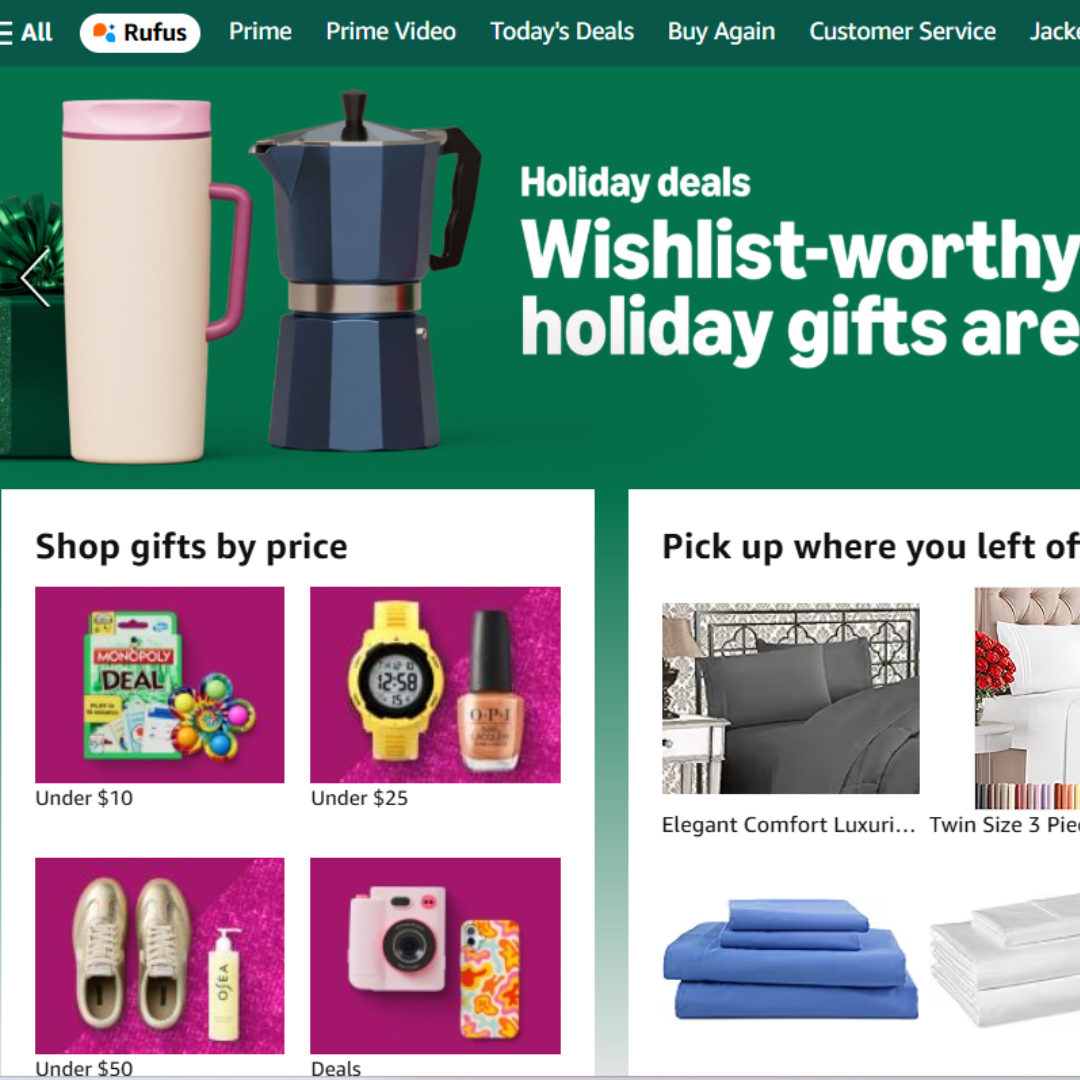
Amazon has been making waves in agentic commerce with a new price-tracking feature that makes purchases once an item falls within a shopper’s specified budget. This feature is an expansion of Rufus, which if you have been following Amazon’s A.I. efforts, has been a gen-A.I. shopping assistant for Amazon users.
The Five Most-Key Takeaways from This Blog Post
- This auto-buy feature is a real step up in agentic commerce, as so far the tech industry has been relatively cautious about having A.I. actually buy items for users. (OpenAI’s Operator preview, for instance, was criticized for being overly cautious when asking permission from users to make decisions when shopping.)
- Saving users from checking in on products to see whether a price drop has occurred can add some convenience to shoppers. This can free up time to shop for other items, or can give shoppers peace of mind in knowing that they will get a product at the price they want it for.
- A “Buy for Me” button also exists, enabling users to have A.I. agentically buy the product for them. Users could also press “Shop Direct”, which goes to a merchant’s website.
- Rufus can give users context for the product prices itself by showing a 30- and 90-day price tracker that shows pricing trends for a particular product. That can inform what the customer sets the agentic-purchase threshold at.
- Rufus will consistently check the product for price drops and auto-buy with default payment method and shipping address. A notification with a free 24-hour cancellation option will be sent in case you end up not wanting the item. Customers can cancel an auto-buy request once setting it, but if they do not cancel it then the request can stay active for up to six months.
The Significance for Business Owners
Business owners in the e-commerce age are of course interested in selling to as many customers as possible in the digital world.
However, the reality is that e-commerce has its own challenges, one of these being meeting customers at the price point that is right for them. The controversial practice of surveillance pricing is one way that some businesses are taking advantage of e-commerce to personalize shopping for users.
Rufus lets consumers flip the script, somewhat, by deciding themselves what price they are willing to pay and only being willing to buy from a company if a product falls within the budget range.
This can motivate business owners to get more competitive on deals and discounts. Because now some Amazon users may not be doing mental justifications to pay a higher or less-than-ideal price for a product, but rather give over the purchasing of the product to Rufus, which will auto-buy when the price is right.
Agentic Commerce, Passive Commerce
The term “agentic commerce” refers to the A.I. agents that do shopping for consumers. Consumers, on the other hand, may well be engaging in something more like “passive commerce”, where they give an A.I. agents a set of instructions and then sit back until the purchase is made.
This can be hugely beneficial for business owners in the long run, as added convenience and passivity in online shopping makes it all the more easier to reach a point of sale for a consumer.
Passive commerce for consumers may also come with less opportunities for second-guessing.
Consider how Amazon will send an after-purchase notification to consumers. Once the thing is bought, how likely are you to really cancel the order? Especially in comparison to deciding whether or not to actually purchase something beforehand.
Consider also how Rufus will spend up to six months monitoring a product’s prices. Six months is more than enough time to put the product to the back of the mind, and not spend much time second-guessing.
The Shopping-Cart Renege
Something that Rufus’ update seems to specifically be targeting is the phenomenon that many of us who have shopped online know well.
That is, when you load up your cart with some items but let the items stay there for a few days, pondering whether you actually want it or not.
What you are really wondering is whether you should actually click “Buy”. With the price-tracking auto-buy feature, users get to make the “Buy” decision upfront, so that they will not be internally debating whether to click “Buy” or empty the cart. Just sit back and let the A.I. do its thing, whenever the price is right.
The Last (But Not Least) Key Takeaway from This Blog Post
Business owners will benefit from agentic commerce because it makes it easier for consumers to reach the point of purchase with less human agency involved. The less steps to take to get to the purchase means that there are less stops to second-guess the purchase.
Other Great GO AI Blog Posts
GO AI the blog offers a combination of information about, analysis of, and editorializing on A.I. technologies of interest to business owners, with especial focus on the impact this tech will have on commerce as a whole.
On a usual week, there are multiple GO AI blog posts going out. Here are some notable recent articles:
In addition to our GO AI blog, we also have a blog that offers important updates in the world of search engine optimization (SEO), with blog posts like “Google Ends Its Plan to End Third-Party Cookies”.
GO Deeper on Substack!
If you want to get a bigger-picture view on where A.I. is and is headed, then check out our Substack to learn about emerging and dominant themes in the A.I. industry that affect all kinds of businesses!